How to Check Names and Numbers in an Instagram Transcript
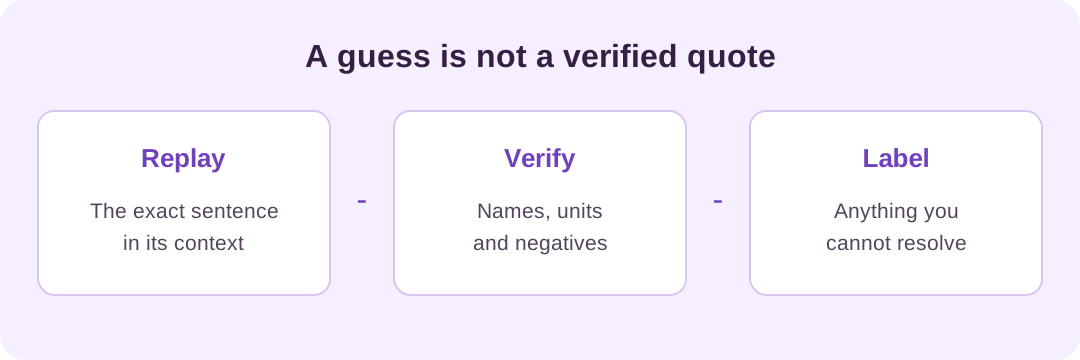
Before quoting an Instagram transcript, replay the exact sentence and check names, numbers, units and negative words against the audio. Keep the generated text as a draft. If you cannot resolve a word, mark it uncertain or leave that part out of your quote; a plausible guess is not a verified quotation.
INSTANT REEL TRANSCRIPT
Get the words from a Reel
Paste a public Instagram Reel link and get its spoken words as text.
Why a readable sentence still needs checking
A transcript can look fluent while changing what the speaker meant. W3C WAI notes that automatic transcription needs correction and that a missing negative can reverse the meaning. Its guidance says to reflect the spoken content and indicate speech that cannot be understood. That is a reason to review the audio, not evidence about the accuracy of our tool or any particular Instagram Reel. W3C WAI: Transcribing Audio to Text.
A quote-check sheet for a short Reel
This is our original review template. The examples below are invented to show the method; they are not statements taken from a real Reel.
| Detail | What to check | What to keep in your notes |
|---|---|---|
| Name | Is - Mara - a person's name, a brand, or an uncertain sound? | Audio spelling may be unresolved. A visible name can be supporting context, but label where that spelling came from. |
| Number and unit | Does - sixteen - belong to seconds, items, or a measurement? | Keep the number with its unit. Do not silently convert it or borrow a unit from a different sentence. |
| Negative word | Did the speaker say - use - or - do not use - ? | Replay the whole instruction. A short isolated sound can be harder to interpret without its surrounding sentence. |
| Who said it | Was this the speaker's instruction or something they quoted from another person? | Retain the attribution. Otherwise a criticism of advice can accidentally become advice attributed to the critic. |
Use two passes instead of editing everything at once
Pass one: meaning. Replay the sentence that you intend to use. Flag any proper name, count, unit, negative, or change of speaker. Keep the original returned wording beside your correction so you can see what changed. If the audio is unavailable, label the quote unverified instead of treating a second transcript tool as confirmation.
Pass two: presentation. Only after the meaning is checked, adjust paragraph breaks and punctuation for readability. Do not improve a speaker's grammar inside a direct quotation or silently combine phrases from separate moments. If you want a smoother explanation, write a clearly labelled paraphrase outside quotation marks.
In our invented example, a draft says - Mara used sixteen. - Before publishing, the reviewer needs to determine what - sixteen - counts and whether Mara is the speaker or someone being discussed. If the unit never becomes audible, the reviewer should not complete the sentence with a guessed word. The review note could read - unit unclear in audio - ; the published explanation can describe that limit without presenting the note as dialogue.
Does another transcript prove the first one was right?
No. Matching text alone is not an audio review. Two outputs may help you spot a difference to investigate, but for the quote-check workflow on this page, the evidence is the original spoken sentence. If you cannot hear it clearly, preserve that uncertainty.
What if a written label uses a different number?
Keep the sources separate. Record what the person said as speech and record the written number as on-screen text. Do not merge the two to make a single confident quote. A mismatch may be useful context to explain, but this page does not establish which source is correct for a particular Reel.
A small review record worth saving
Save the public Reel URL, the sentence you reviewed, the approximate position where it appears, your corrected wording, and any remaining uncertainty. This is an editorial recommendation, not a claim that our tool automatically records those fields. Keep a paraphrase visibly separate from a quotation so the next reader can understand what was checked.
Primary source checked on 1 October 2026: W3C WAI, Transcribing Audio to Text. Review template, two-pass method and scenarios are original instructional material. No tool-accuracy percentage or user-test result is asserted.